Two jobs with different questions
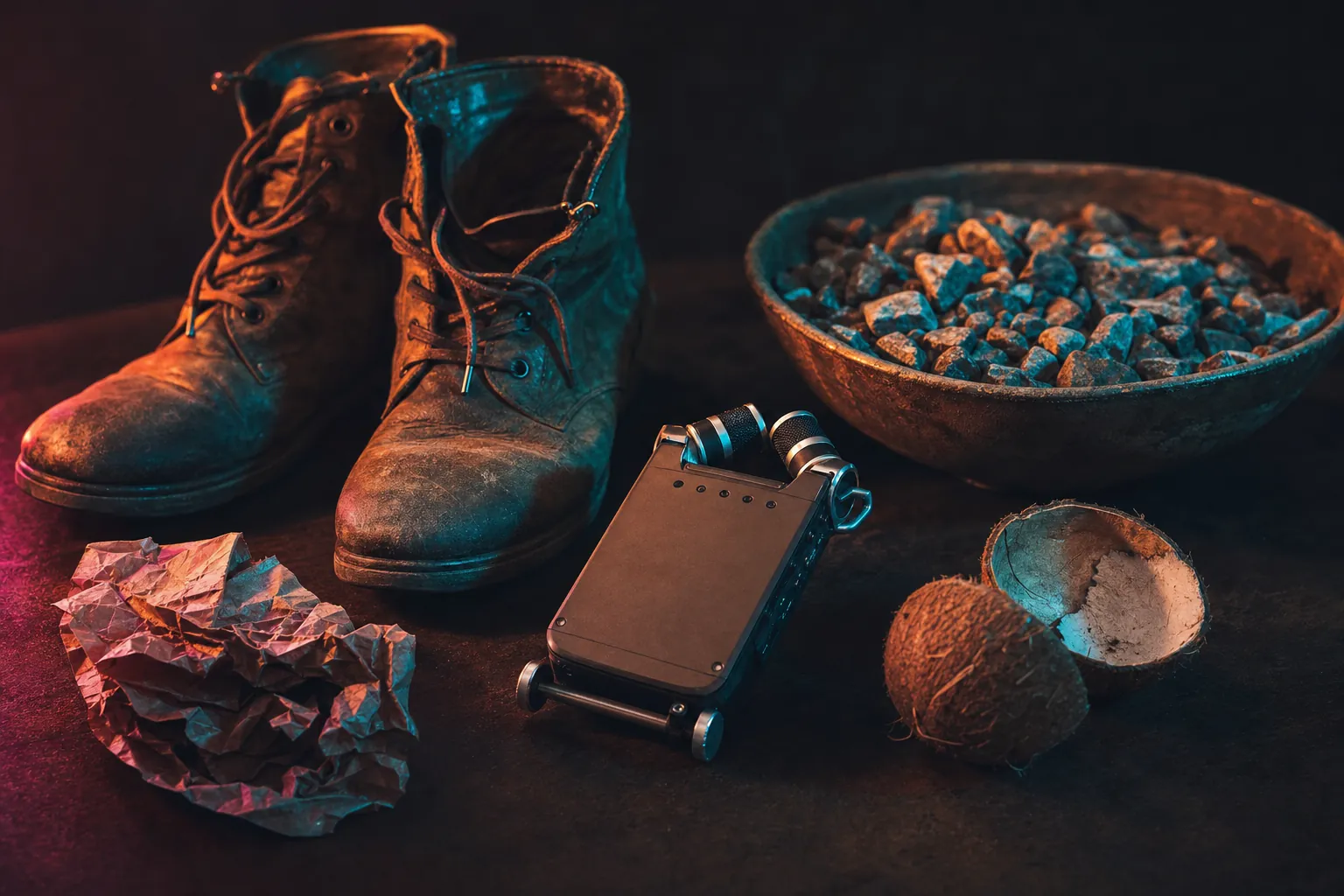
Sound design covers the sounds of the game world and its interface: footsteps, weapons, doors, engines, menus, notifications and ambient backgrounds such as wind or crowds. Its main job is to tell the player what is happening and to make the world feel solid.
Music, by contrast, mainly shapes mood, pacing and emotion. It tells the player how to feel about what is happening rather than what is happening. A sound designer asks what a sword hitting armour sounds like; a composer asks what the fight should feel like.
In practice, both serve the same goal, and there is a lot of overlap. A tense drone might come from either department, and a short musical sting might count as a sound effect.
Ambience sits between the two. Background layers of wind, birdsong or distant machinery are usually built by sound designers, but they are arranged with the same care for mood and pacing as a piece of music.
Diegetic and non-diegetic sound
Two terms borrowed from film studies help make the distinction clearer:
- Diegetic sound exists inside the game world. Characters could hear it: a radio playing in a room, a band performing in a tavern, the ocarina tunes the player plays in Ocarina of Time.
- Non-diegetic sound exists only for the player: the score playing over a battle, or the chime when you open a menu.
Games play with this boundary often. A song might start on an in-game radio and then swell into the full score, or a character might sing a melody that the background music then picks up. Supergiant's games, scored by Darren Korb, are often discussed for blending songs into the story in this way.
When the music is the sound effect
The boundary has been blurred since the earliest games. In Space Invaders (1978), the background sound is four descending bass notes that repeat in a loop and speed up as the invaders advance. It is both a sound effect, telling the player about the threat, and a piece of music.
On early consoles, music and effects also shared the same sound channels. Koji Kondo's music for Super Mario Bros. was revised during development partly so that it harmonised with the game's sound effects and matched Mario's movement, as described on his profile. Our sound chips explainer explains why effects often interrupted the music on those machines.
Who does what in a game audio team
Job titles vary between studios, but these are the common roles:
- Composer: writes, and often produces, the music. May be on staff or freelance.
- Sound designer: creates and edits sound effects and ambiences, often from recordings, synthesis and libraries.
- Technical sound designer or implementer: sets up how sounds and music behave in the game, usually in middleware such as FMOD or Wwise.
- Audio programmer: writes the code that connects audio systems to the game engine and builds custom tools.
- Dialogue or voice team: casts, records and edits spoken lines.
- Audio director: oversees the overall sound of the game and how all of the above fit together.
On small teams, one person may cover several of these. Darren Korb is audio director and composer at Supergiant Games, and Martin O'Donnell was audio director at Bungie while co-composing the Halo scores, as described on his profile.
Sharing the mix: frequency, priority and ducking
All of these sounds play through the same speakers or headphones at once. If they all compete, the result is a muddy wall of noise and the player misses important information, such as an enemy's footsteps or a line of dialogue.
Game audio teams use several techniques to keep things clear:
- Prioritisation: deciding which sounds matter most at any moment, and limiting how many can play at once.
- Ducking: automatically lowering the music or ambience when someone speaks.
- Frequency space: arranging music so that it leaves room in the range where voices and key effects sit.
- Dynamic mixing: changing the overall balance depending on the situation, for example bringing up effects and lowering music in a tense stealth section.
Composers who understand these constraints can write music that works with the mix rather than against it.
Designing music and sound together from the start
Many of the most praised game soundtracks were planned alongside the sound design. In Journey (2012), composer Austin Wintory worked with sound designer Steve Johnson so that the music tied in with both the player's actions and the sound effects of nearby objects. The game won BAFTA awards for both Audio Achievement and Original Music in 2013, as noted on his profile.
When music and sound design are planned together, a musical phrase can resolve on the sound of a door opening, or ambient sounds can be tuned to the key of the score. Those details are rarely noticed consciously, but they make a game feel coherent.
Silence as a deliberate choice
One of the most important decisions in game audio is when not to play music at all. Long stretches without a score can make a world feel more real and let ambient sound carry the mood. When music then returns, it has more impact.
Minecraft is a well-known example: its music plays occasionally rather than constantly, leaving long periods in which players hear only the world around them. Horror games often use silence and quiet ambience to build tension, saving music for key moments.
Deciding where music should drop out is a joint decision between the composer, sound designers and the game's designers. It depends on what the player needs to hear: in a stealth section, footsteps and enemy voices may be more important than any score. The result is that a game's soundtrack is shaped as much by its gaps as by its music.
Using game settings to hear each part separately
Most games let you adjust music, effects and dialogue volumes separately in their audio settings. Turning one down at a time is a simple way to hear how much each part contributes, and many players find it changes how they think about game audio.
Those settings are also useful for accessibility. Lowering music can make dialogue clearer, and some games offer subtitles that describe important sounds. If you are interested in the music on its own, our concerts page covers where to hear game scores performed live in the UK.
Questions readers ask
Is sound design the same as composing?
No. Sound design creates the sounds of the game world and interface, such as footsteps and menus. Composing creates the music. The two often overlap and are planned together.
What does diegetic mean in games?
Diegetic sound exists inside the game world, so characters could hear it, such as a radio playing. Non-diegetic sound, such as most background music, is heard only by the player.
What is ducking in game audio?
Ducking automatically lowers one sound, usually music, when another more important sound such as dialogue plays, so the important sound stays clear.
Sources we checked
- Video game music, Wikipedia
- Super Mario Bros. theme, Wikipedia
- Journey (2012 video game), Wikipedia
- Darren Korb, Wikipedia
Last checked: . Spotted something out of date? Tell us.