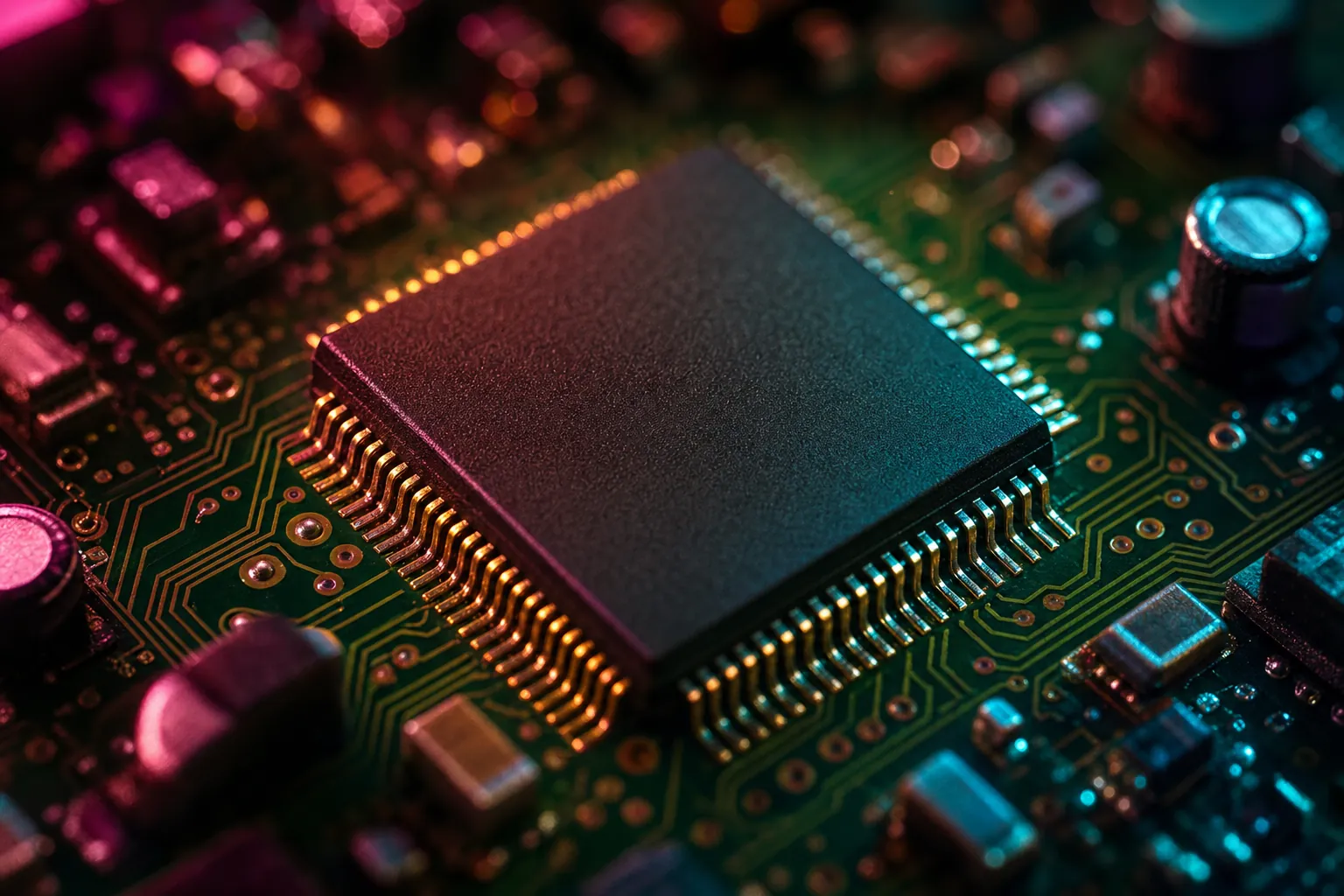
A synthesiser on a chip, not a recording
A modern game usually plays back recorded audio files, much like a music streaming app. Early consoles and home computers did something quite different. They contained a programmable sound generator: a chip that could produce a handful of simple waveforms at chosen pitches and volumes. The game's code told the chip which note to play on which channel, and when.
This had two consequences. First, the music took up very little storage, because it was stored as instructions rather than as sound. Second, the composer was limited by the chip's design. If a chip had three voices, no more than three notes could sound at once, and sound effects often had to borrow one of those voices, briefly interrupting the music.
Composers frequently had to program the music themselves, either directly in code or using a simple tool written by the studio. Our arcade era page shows how this began, with music that was often little more than a few repeating notes.
Inside the NES: two pulses, a triangle, noise and samples
The Nintendo Entertainment System, known in Japan as the Famicom, had five sound channels built into its main processor. Each had a clear job:
- Two pulse channels. These produce a square-ish wave whose width, or duty cycle, could be set to 12.5%, 25%, 50% or 75%. Narrower pulses sound thinner and more nasal; 50% gives a fuller, hollow tone. Melodies and harmonies usually lived here.
- A triangle channel. This produces a softer tone built from 32 steps, with no volume control beyond on and off. It was typically used for bass lines.
- A noise channel. This generates pseudo-random noise for percussion and effects such as explosions. A second mode produces a buzzier, more tonal noise.
- A delta modulation channel (DMC). This plays back very low-resolution samples, which some games used for drums or short voice clips.
So a typical NES track has two melodic or harmonic lines, a bass and percussion. Koji Kondo's music for Super Mario Bros. (1985), covered on his profile, is a well-known example of how much could be done within that set-up.
The Commodore 64 SID: a home computer with a real synthesiser
The MOS Technology 6581, better known as the SID (Sound Interface Device), was designed by Bob Yannes and used in the Commodore 64 from 1982. It had three voices, but each voice was much more flexible than an NES channel. Every voice could produce triangle, sawtooth, pulse or noise waveforms, and had its own ADSR envelope, which controls how a note starts, holds and fades.
The SID also had a multi-mode filter offering low-pass, high-pass and band-pass settings, along with ring modulation and oscillator sync. Those features are standard parts of analogue synthesisers, and they let composers sweep and shape sounds in ways other home-computer chips could not. Yannes, who had a background in electronic music, set out to design a chip that worked as a musical instrument rather than a sound-effects generator.
The Commodore 64 was hugely popular in the UK, and many British composers of the 1980s wrote for the SID. A later revision, the 8580, changed the filter behaviour, which is why some music sounds slightly different depending on which version of the computer it is played on.
Game Boy and Mega Drive: wave tables and FM synthesis
Nintendo's Game Boy, released in 1989, had four channels: two pulse channels, a wave channel and a noise channel. The wave channel could play a short, user-defined waveform, which gave composers a little more choice of timbre. The console had a single mono speaker, but its headphone socket delivered stereo sound.
Sega's Mega Drive, sold in North America as the Genesis, took a different approach. Its main sound chip, the Yamaha YM2612, used FM (frequency modulation) synthesis, with six channels each built from four operators. By combining operators in different ways, composers could create metallic, bell-like and punchy bass sounds that were hard to achieve on pulse-wave chips. The sixth channel could also switch to playing 8-bit digital samples, often used for drums or speech. A second, simpler chip, the SN76489, added further square-wave and noise channels.
FM synthesis is the reason Mega Drive music has a recognisably bright, edgy character. Our 16-bit era page compares it with its main rival.
How the Super Nintendo moved from synthesis to samples
The Super Nintendo's audio system, designed by Ken Kutaragi at Sony, worked very differently from the chips above. It had its own sound processor, the SPC700, and a digital signal processor that mixed eight voices of sampled sound, with effects including echo. Instead of generating simple waveforms, it played short recordings of real or synthesised instruments, compressed to fit into 64 KB of dedicated audio memory.
That shift from synthesis to samples meant composers could use something closer to a piano, string section or drum kit. The catch was memory: every instrument had to be very short and heavily compressed, so a soundtrack might rely on a few seconds of each sound, looped and repitched. David Wise's work on Donkey Kong Country, described on his profile, is often cited for how much atmosphere it got from that small space.
Arpeggios, duty sweeps and other tricks to cheat the limits
Working with so few voices led to techniques that now define the chiptune sound:
- Fast arpeggios. A chord needs several notes at once. Playing the notes of a chord in very quick succession on a single channel makes the ear hear something close to a chord while using only one voice.
- Duty-cycle changes. Switching a pulse channel's width during a note changes its tone, giving movement and expression to a simple sound.
- Vibrato and pitch bends. Small, rapid changes to pitch, programmed note by note, make a lead line sound more like a singer or a lead guitar.
- Echo by repetition. Repeating a melody a fraction later at a lower volume on a second channel imitates an echo effect.
- Shared percussion. Noise bursts, short pitch drops and sample snippets were combined to suggest a full drum kit.
None of these tricks are unique to games, but the constraints made them essential, and listeners came to associate them with the sound of the period.
Chiptune as a style long after the hardware
When consoles moved to CD and streamed audio in the mid-1990s, sound chips stopped being a necessity. The sound did not disappear. Musicians kept writing music for old hardware, or for software that recreates it, and chiptune became a genre in its own right, played at gigs and released on albums with no game attached.
Some musicians use original consoles and computers, others use emulated chips inside modern music software, and hardware reimplementations of chips such as the SID are still made. Many modern independent games also choose a chip-style soundtrack deliberately, as an aesthetic choice rather than a technical limit. For how the end of the cartridge era changed game music, see our page on CD audio and the 90s.
Questions readers ask
What is chiptune?
Chiptune is music made with, or in imitation of, the sound chips found in older consoles and home computers. It uses simple waveforms such as pulse, triangle and noise, and techniques such as fast arpeggios.
How many notes could the NES play at once?
The NES had five sound channels: two pulse, one triangle, one noise and one sample channel. In practice that usually meant two melodic lines, a bass line and percussion at the same time.
Why does Mega Drive music sound different from Super Nintendo music?
The Mega Drive mainly used FM synthesis from a Yamaha YM2612 chip, which gives bright, metallic tones. The Super Nintendo played compressed samples of instruments through Sony-designed hardware, which sounds closer to recorded instruments.
Sources we checked
- APU reference, NESdev Wiki
- MOS Technology 6581 (SID), Wikipedia
- Game Boy, Wikipedia
- Yamaha YM2612, Wikipedia
- Super Nintendo Entertainment System, Wikipedia
- Video game music, Wikipedia
Last checked: . Spotted something out of date? Tell us.