Landmark scores of the era
- 2008Braid Licensed from Magnatune artists Cheryl Ann Fulton, Shira Kammen and Jami SieberTracks were chosen partly because they sound interesting when played backwards as the player rewinds time.
- 2011Minecraft – Volume Alpha C418 (Daniel Rosenfeld)Gentle ambient piano released on Bandcamp; added to the US National Recording Registry in 2025.
- 2011Bastion Darren KorbRecorded largely in a New York apartment closet; Korb described the style as acoustic frontier trip-hop.
- 2012Fez Disasterpeace (Rich Vreeland)Soft synthesiser pads and reverb, with hidden images embedded in the audio.
- 2015Undertale Toby FoxWritten by the game's creator in FL Studio, with recurring character motifs across many tracks.
- 2017Hollow Knight Christopher LarkinA melancholy chamber-style score for Team Cherry's small Adelaide studio.
- 2018Celeste Lena RaineEach character has an instrumental identity; the score won the Game Developers Choice Award for Best Audio.
Why the indie boom was also a music boom
In the late 2000s, digital stores on consoles and PC made it possible for very small teams to publish games without a traditional publisher. Composers benefited in two ways. First, there were many more games needing music. Second, the same digital channels let them sell soundtracks directly, often on the same day as the game.
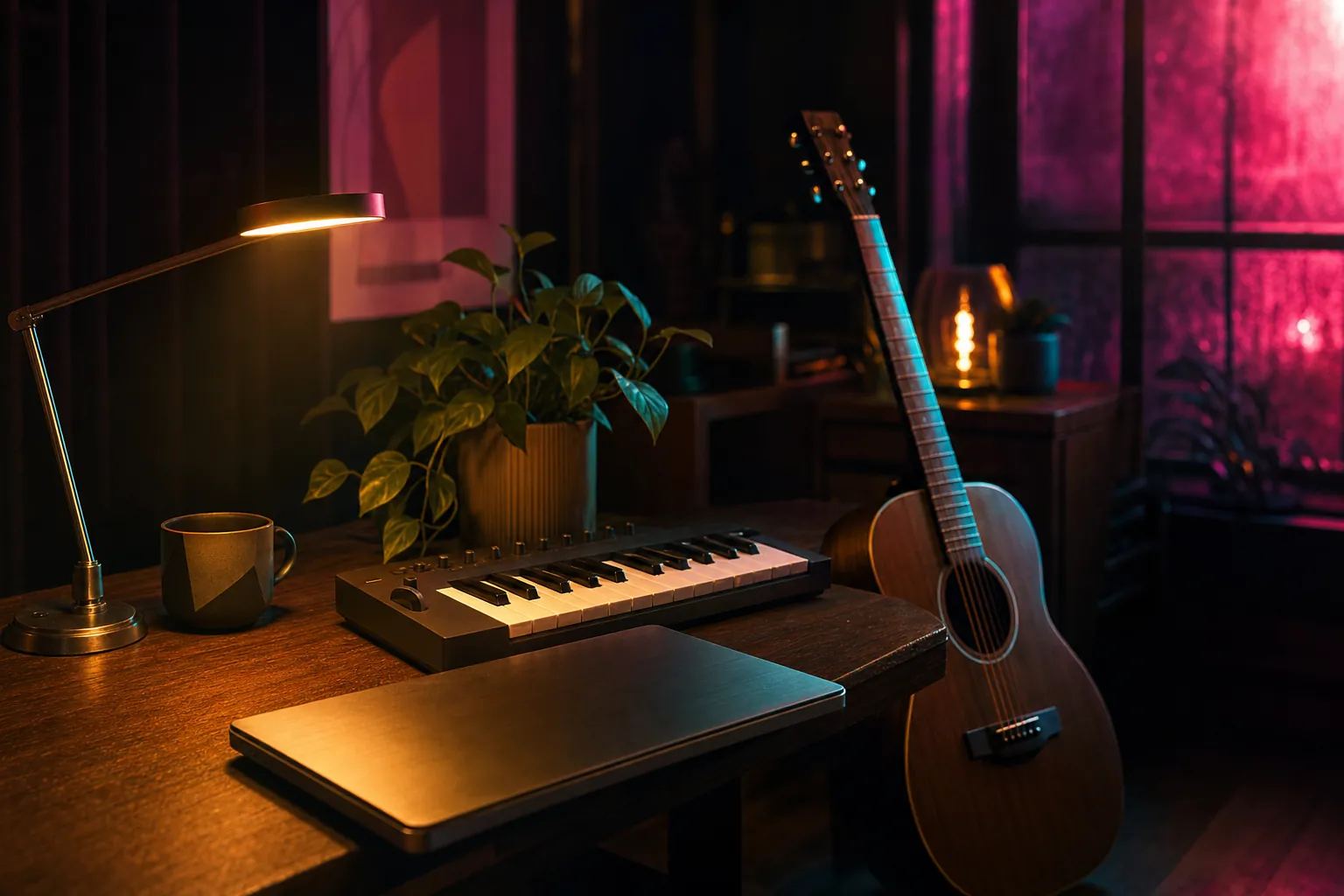
Home-studio tools had become powerful and affordable. A laptop with a digital audio workstation, a few software instruments and a decent microphone could produce professional results. Many indie composers combine live recording of a few instruments with software for everything else, an approach our guide to getting into game music discusses in more detail.
This era is still going on, so there is no neat end date. What marks it out is not one technology but a change in who makes game music and how listeners find it.
Braid, Fez and music as a puzzle
Jonathan Blow's Braid (2008) did not commission an original score. Instead it licensed tracks from Magnatune artists Cheryl Ann Fulton, Shira Kammen and Jami Sieber. The pieces were chosen to be long enough to avoid obvious looping during difficult puzzles and to sound different and interesting when played in reverse, because the player can rewind time.
Fez (2012) took a composed route. Rich Vreeland, who works as Disasterpeace, spent around 14 months on a score that uses soft synthesiser pads and reverb to suggest 1980s synth music without copying chiptune directly. Some areas are deliberately left without music. Vreeland also hid images in the audio, visible only when the sound is viewed as a spectrogram, which fits a game built around secrets.
Both games treat music as part of the design rather than decoration. That attitude became common among independent developers, partly because composers were often involved from early in a project.
Selling direct: Bandcamp and the Minecraft soundtrack
Bandcamp, launched in 2008, gave musicians a simple way to sell downloads directly to fans. Daniel Rosenfeld, known as C418, released Minecraft – Volume Alpha there on 4 March 2011. The gentle, mostly piano-based music was partly shaped by the limits of the game's sound engine. A physical CD and vinyl release followed in 2015 through the label Ghostly International.
The album's reach has been remarkable. Its track Sweden became, as of April 2021, the most-streamed piece of video game music on Spotify, and in April 2025 the Library of Congress added the album to the US National Recording Registry, only the second piece of game music to be included after the Super Mario Bros. theme.
For many composers, Minecraft showed that direct sales and streaming could support a career. The model is now standard: indie soundtracks commonly appear on digital stores, Bandcamp and streaming services at launch.
Composer-developers: Bastion and Undertale
Supergiant Games' Bastion (2011) was Darren Korb's first game score. He recorded it, along with sound effects and narration, in a closet in his New York apartment, and described the style as acoustic frontier trip-hop: sampled beats layered with acoustic instruments. The soundtrack, released digitally in August 2011, sold 30,000 copies by that November, and it has been reissued on vinyl more than once.
Toby Fox went further: he made Undertale (2015) almost single-handedly and wrote all its music himself in FL Studio. Over 90 per cent of the tracks were composed for the game, and Fox often wrote the music for a scene before programming it. The score reuses character motifs across many tracks, so melodies change meaning as the story unfolds. It has since become one of the most widely performed indie scores in concert, and a touring symphonic show visits UK venues in 2026; see our live page.
Hollow Knight, Celeste and the emotional indie score
Christopher Larkin's music for Hollow Knight (2017), made by Team Cherry in Adelaide, uses a chamber-like palette to give a vast underground world a sense of sadness and history. Lena Raine's score for Celeste (2018) gives each character an instrumental identity: piano for the main character, synthesiser for her darker reflection, guitar for a friend, and a theremin-like synth for a ghostly hotel owner. Raine worked closely with sound designer Kevin Regamey, and the soundtrack won the Game Developers Choice Award for Best Audio in 2019.
These scores are not small in emotional ambition, even when budgets were. They show how much the indie scene has shaped expectations of what game music can do: tell a story through instruments, carry a character's inner life and reward close listening. To compare how recurring themes work across scale, see leitmotifs in games.
Retro sounds as a deliberate choice
Many indie games of this period chose sounds associated with earlier hardware. That was rarely a technical necessity. A modern computer can play an orchestra as easily as a square wave, so using chip-like sounds is an aesthetic decision, often tied to a game's pixel-art look or to a sense of nostalgia.
Composers handle this in different ways. Some write strictly within the limits of a real chip, using only the channels and waveforms the original hardware offered. Others, like Disasterpeace on Fez, borrow the flavour of older synthesisers but add modern reverb, softer pads and wider stereo. Toby Fox's Undertale draws on Super NES role-playing games without being confined to their sound.
This mix of old and new tools has helped keep chiptune and synthwave-style music in circulation for a new generation of players. It also shows a wider point about game music: limits that were once imposed by hardware can later be chosen freely, because they shaped a sound people still enjoy. For how those chip sounds are built, see sound chips and chiptune.
Physical editions and the collector market
Alongside downloads and streaming, specialist record labels now press game soundtracks on vinyl and even cassette. Bastion's soundtrack received vinyl reissues in 2017 and 2023, and Minecraft – Volume Alpha has been issued on CD, vinyl and, in 2025, cassette. These editions are often limited runs, so availability varies.
If you collect, buy from the label or the composer's official store where possible, since that is how the money reaches the people who made the music. The next era, adaptive and modern, looks at the tools that let today's scores react to every move the player makes.
Questions readers ask
Who composed the Minecraft music?
Daniel Rosenfeld, known as C418. Minecraft – Volume Alpha was released on Bandcamp in March 2011.
What software was Undertale's music made in?
Toby Fox wrote the soundtrack in FL Studio.
Why does Braid's music sound strange when rewinding?
The licensed tracks were chosen partly because they sound interesting played backwards, which happens when the player rewinds time.
Is indie game music only electronic?
No. Many indie scores mix live acoustic instruments with software, such as Bastion's acoustic guitars over sampled beats.
Sources we checked
- Wikipedia: Braid (video game)
- Wikipedia: Fez (video game)
- Wikipedia: Bastion (video game)
- Wikipedia: Minecraft – Volume Alpha
- Wikipedia: Undertale
- Wikipedia: Hollow Knight
- Wikipedia: Celeste (video game)
- Wikipedia: Bandcamp
Last checked: . Spotted something out of date? Tell us.