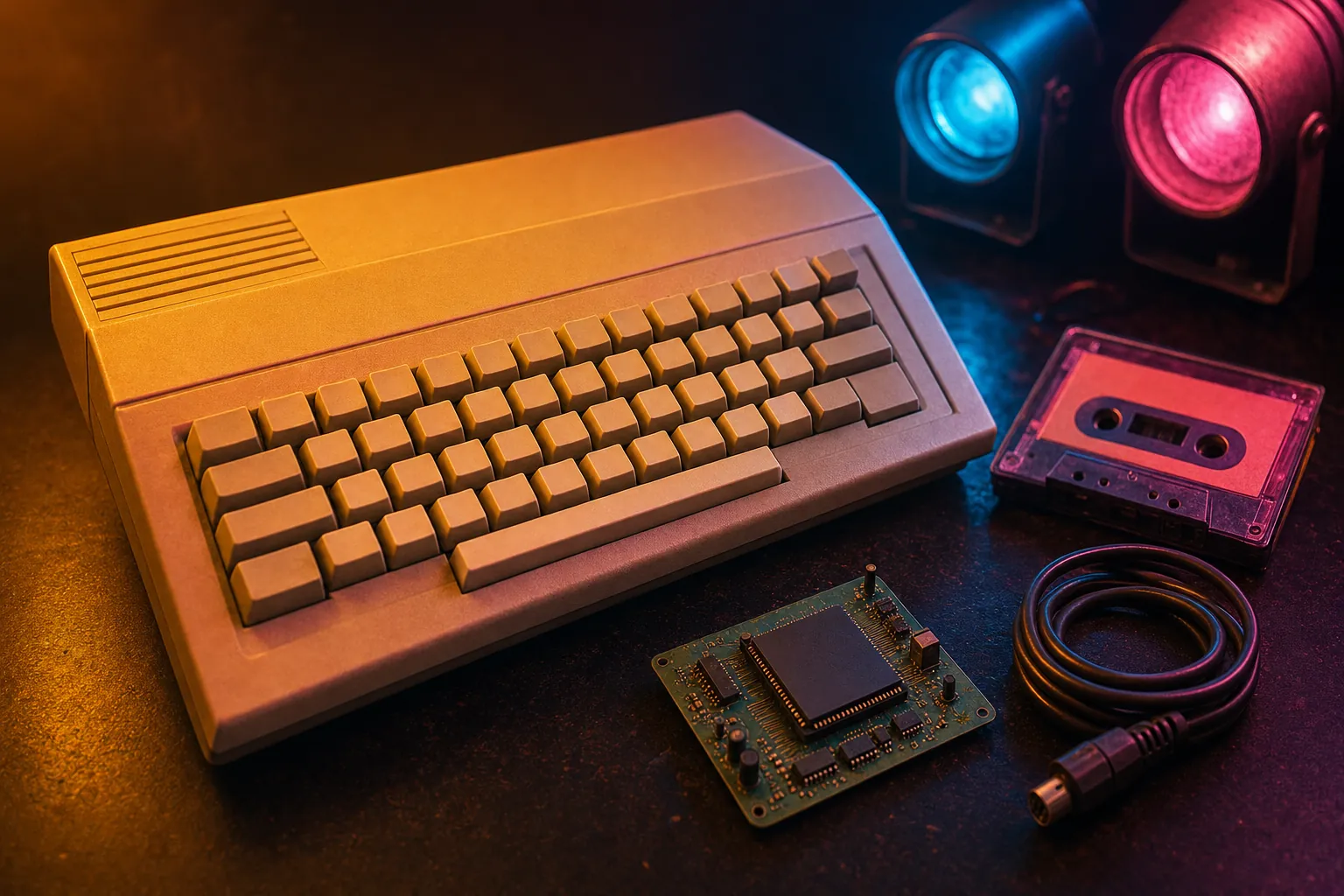
Landmark scores of the era
- 1985Super Mario Bros. Koji KondoKondo's first major score; the main theme was the first video game music added to the US National Recording Registry.
- 1985Monty on the Run (Commodore 64) Rob HubbardOne of the best-known SID scores by the Hull-born composer, whose UK work defined home-computer music.
- 1986The Legend of Zelda Koji KondoA small set of themes built a sense of adventure and exploration on the same NES hardware.
- 1986Dragon Quest Koichi SugiyamaIts classically influenced score and set of core melodies became a template for many role-playing game soundtracks.
- 1986Castlevania Kinuyo Yamashita and Satoe TerashimaGothic, driving themes written to evoke classic horror films.
- 1987Final Fantasy Nobuo UematsuThe start of one of the longest-running partnerships between a composer and a game series.
- 1988Mega Man 2 Takashi Tateishi (with Manami Matsumae)Fast, melodic stage themes that are widely covered by bands and chiptune artists.
Five channels in a grey box: what the NES could actually play
Nintendo's Famicom launched in Japan in 1983 and reached Europe as the NES in the following years. Its sound came from the Ricoh 2A03, a chip that combined the processor with an audio unit offering five channels. Two produced pulse (square) waves with four selectable duty cycles, which changed the tone from thin and reedy to full and hollow. One produced a triangle wave, often used for bass. One generated noise, used for drums and explosions. The fifth was a 1-bit delta modulation channel that could play simple samples.
Most early games used only the first four. Memory on cartridges was expensive, so samples were a luxury. Later titles such as Super Mario Bros. 3 and Kirby's Adventure made more use of the fifth channel as storage became cheaper. In practice, composers usually had three melodic lines and a drum part to work with. Every chord had to be implied, every harmony squeezed between melody and bass.
That constraint encouraged a particular kind of writing: strong, singable melodies, quick arpeggios to suggest chords, and rhythms that keep moving. The style is now known as chiptune, and it has a life far beyond games. Our explainer on sound chips and chiptune shows how those channels are combined.
Koji Kondo and the theme that became a national recording
Koji Kondo joined Nintendo in 1984. His first major score, for Super Mario Bros. (1985), produced a main theme that is now among the most recognised pieces of music of the late 20th century. In 2023 it became the first piece of video game music added to the US National Recording Registry, which preserves recordings judged culturally, historically or aesthetically significant.
The following year Kondo scored The Legend of Zelda (1986), producing a small number of main background pieces for a game built around exploration. Where Mario's music bounces with the jumping, Zelda's themes lean towards adventure and discovery. Kondo's work showed that a handful of carefully written loops could give a whole game its personality.
Elsewhere in Japan, other composers were establishing their own voices. Koichi Sugiyama, already known for television and pop work, scored Dragon Quest (1986). Its set of core melodies became a model for many role-playing games that followed. Kinuyo Yamashita and Satoe Terashima gave Castlevania (1986) a gothic drive designed to recall horror films. In 1987 Nobuo Uematsu scored the first Final Fantasy, beginning a long association with the series. And Takashi Tateishi, credited under a pseudonym, wrote the fast-paced stage themes of Mega Man 2 (1988), with Manami Matsumae contributing material from the first game.
Britain's bedroom computers: the SID, the beeper and the AY
In the UK the story of the 1980s is as much about home computers as consoles. The Sinclair ZX Spectrum, released in April 1982 and manufactured in Dundee, was enormously popular, but its original sound was a single-channel beeper. Sound was made by switching one bit on and off, and the processor was fully occupied while it did so. Composers found clever ways round this, but music during play was hard.
The Commodore 64, which arrived in 1982, was different. Its MOS Technology 6581, better known as the SID, was designed by engineer Bob Yannes with music in mind. It offered three independent voices, each able to produce triangle, sawtooth, pulse or noise waveforms, and an analogue filter with low-pass, band-pass and high-pass modes. The filter in particular gave C64 music a warmth and movement closer to an analogue synthesiser than a simple beeper.
Later machines narrowed the gap. The ZX Spectrum 128 added an AY-3-8912 chip with three channels, and the Amstrad CPC used the same family of chips. Across Europe, a generation of composers learned to write directly in code, often building their own music routines to make the most of each machine.
Rob Hubbard and the UK composers who programmed their music
Rob Hubbard, born in Kingston upon Hull in 1955, is one of the best-known figures of this scene. His Commodore 64 scores include Monty on the Run and Commando (both 1985), International Karate and Sanxion (both 1986) and Delta (1987). Hubbard wrote his own playback code, which let him use techniques such as rapid arpeggios and pulse-width changes that made three voices sound fuller.
In 1988 he joined Electronic Arts, becoming its first person dedicated to sound and music, and later rose to Audio Technical Director before returning to England in 2002. Abertay University in Dundee awarded him an honorary degree in 2016 for his contribution to game music. His C64 pieces have since been performed live by orchestras and bands, a sign of how seriously this once-overlooked music is now taken.
Hubbard was one of many. The UK industry of the period had a large number of composers writing for the C64, Spectrum and Amstrad, and their music is now preserved and studied by enthusiasts. What united them was the need to be part musician, part programmer. There was no separate audio team; the person who wrote the tune often wrote the code that played it.
Why 8-bit melodies stick in the memory
Ask why music from this period is so memorable and you will hear several explanations. The limits forced composers to prioritise melody, because there was little room for texture. Loops had to survive being heard hundreds of times, so they were written to be catchy without becoming irritating. And because the sound of each chip was distinctive, a few notes are often enough to identify a whole platform.
There is also a practical reason. Many players spent long periods on a single level, so its music became deeply familiar. Composers responded with themes that changed subtly on repetition or broke into new sections to avoid monotony. Those habits, writing for repetition and giving each area its own identity, are still central to game scoring. You can see how recurring themes work in our explainer on leitmotifs in games.
When the 16-bit consoles arrived, they did not replace these ideas so much as give them more room. The next chapter, the 16-bit era, follows what happened when composers suddenly had samples, FM synthesis and stereo.
Where 8-bit music lives now
Music from this era survives in several forms. Official re-releases and collections on modern platforms let you hear the original sound. Orchestral and band arrangements regularly appear in concert programmes, some of which are listed on our live concerts page. And chiptune, music written for or inspired by these chips, is a thriving genre in its own right, with musicians using original hardware or software that imitates it.
If you would like to try composing in this style, free tracker programmes designed around the NES and C64 sound models exist; look for well-maintained open-source projects and download them only from their official pages.
Questions readers ask
How many sound channels did the NES have?
Five: two pulse waves, one triangle wave, one noise channel and one DPCM channel for simple samples. Many games used only the first four.
What made the Commodore 64 sound different?
Its SID chip had three voices with four waveforms each and an analogue filter, which gave it a richer, more synthesiser-like tone than most rivals.
Who composed the Super Mario Bros. theme?
Koji Kondo, who joined Nintendo in 1984. The game was released in 1985.
Could the ZX Spectrum play music?
The original model had a single-channel beeper, which made music during play difficult. The ZX Spectrum 128 added a three-channel AY-3-8912 chip.
Sources we checked
- Wikipedia: Ricoh 2A03
- Wikipedia: MOS Technology 6581
- Wikipedia: ZX Spectrum
- Wikipedia: General Instrument AY-3-8910
- Wikipedia: Koji Kondo
- Wikipedia: Rob Hubbard
- Wikipedia: Dragon Quest (video game)
- Wikipedia: Castlevania (1986 video game)
- Wikipedia: Mega Man 2
- Wikipedia: Nobuo Uematsu
- Library of Congress: National Recording Registry
Last checked: . Spotted something out of date? Tell us.